Resilience, Softness, and Reinvention
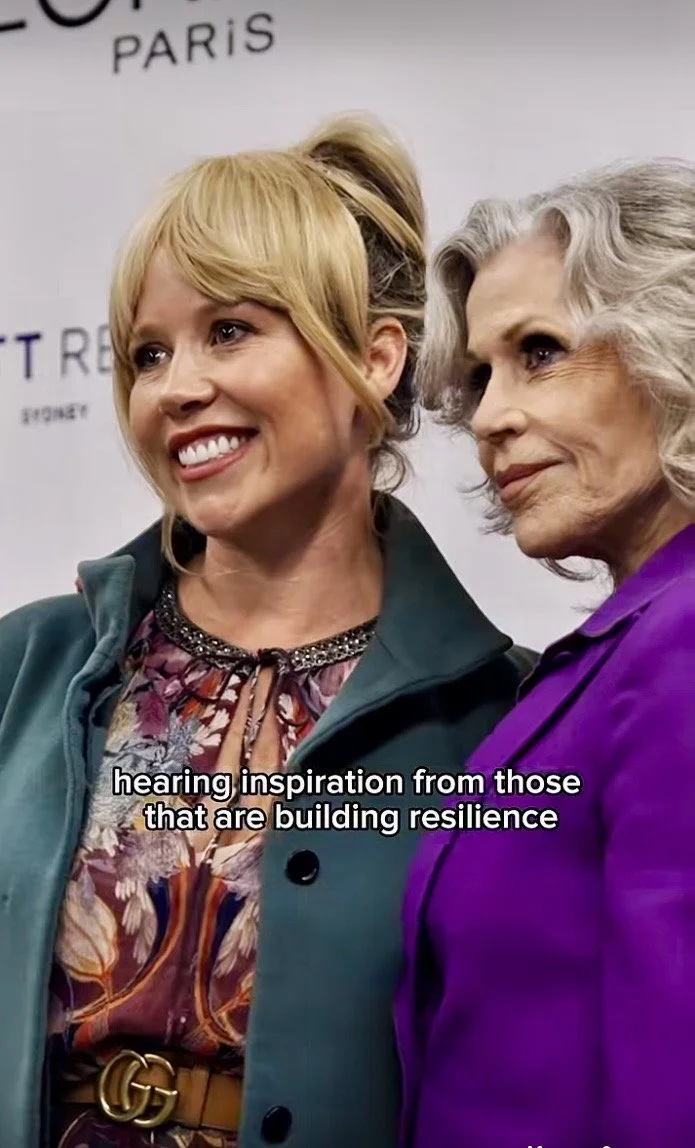
Jane Fonda and Kaja Troa - WANDERLUST 2025
Lessons in Strength, Femininity, and Survival from a Life Lived Across Stages, Boardrooms, and Yoga Mats
Resilience is often spoken about as something we build in response to crisis. But for many of us, resilience is learned long before we have the language for it — through repetition, rejection, reinvention, and the quiet decision to keep going.
For me, resilience has been shaped across many worlds: the entertainment industry, corporate life, motherhood, wellness, love, loss, and rebuilding. Most recently, reflecting at The Wanderlust Sessions, inspired by women like Jane Fonda, Marianne Williamson, and Pamela Anderson, I found myself revisiting what resilience truly means — especially for women.
Not resilience as hardness.
But resilience as soft power.
The First Training Ground: Life as an Actor
Before the corporate world, before resilience frameworks and leadership training, my first real education in resilience came through the entertainment industry.
Life as an actor — balancing multiple jobs, navigating uncertainty, and showing up repeatedly for auditions and castings — is an extraordinary teacher. It requires courage, emotional availability, discipline, and a deep relationship with rejection.
You learn early that:
“No” is rarely personal
Preparation does not guarantee outcomes
Confidence must come from within
And self-worth cannot be outsourced to external validation
Auditioning teaches you how to stand in your truth, deliver your best, and then let go. It demands resilience not as a concept, but as a daily practice — especially when your livelihood depends on it.
Looking back, I see now that those years quietly shaped my capacity to adapt, self-regulate, and remain open-hearted in uncertain environments. They taught me how to recover, recalibrate, and return — again and again.
Corporate Resilience: Naming What I Already Knew
Over a decade ago, during my first Corporate Resilience Training at the Reserve Bank of Australia, we were asked to choose a mentor.
I chose a senior manager — a woman with a doctorate, a long and respected career, and two beautiful children. What stood out wasn’t just her achievements, but her steadiness. She seemed grounded, calm, and whole. She didn’t merely survive complexity — she thrived within it.
At the time, I admired her. Now I understand her more clearly.
She embodied something I was still learning to claim:
You can hold responsibility, ambition, family, and self-respect — without abandoning yourself.
When Resilience Became Non‑Negotiable
Life, of course, continued to evolve.
After years of burnout, deep exhaustion, and eventually divorce, resilience stopped being aspirational and became essential.
There is a particular kind of resilience that emerges not from ambition, but from necessity. The kind that asks you to listen more closely to your body. To tell the truth sooner. To rest without apology. To choose yourself — not out of ego, but survival.
From that point on, resilience became a non‑negotiable.
Not the performative kind.
The practical, embodied kind.
Softness, Femininity, and True Power
One of the most profound lessons I’ve learned is this:
There is true power in softness.
Softness does not mean weakness.
Softness is not passivity.
Softness is strength that is regulated, responsive, and deeply rooted.
Honouring femininity, for me, has meant embracing intuition, emotional honesty, receptivity, and rest — alongside clarity, boundaries, and assertiveness. It has meant allowing myself to lead, parent, work, and create without armouring up.
Softness allows resilience to be sustainable.
Why Yoga Became My Mission
After burnout and major life transition, I found myself returning again and again to practices that brought me home to myself.
Yoga became a personal survival tool.
A way to regulate my nervous system.
A way to feel safe in my body again.
A way to process grief, change, and renewal — without words.
Over time, what supported me personally became something I felt called to share. Sharing yoga became a mission — not as a solution, but as a set of accessible, embodied resilience tools. Because resilience lives in the body as much as the mind.
My Personal Resilience Toolkit
These are the practices I return to — especially while navigating life in my late 40s, with a happy family, a young child, corporate and project-based work, and community wellness leadership.
Boundaries
Boundaries are clarity in action. They protect energy, time, and wellbeing.
Authenticity
Living truthfully reduces inner conflict — one of the biggest drains on resilience.
Effective Communication & Assertiveness
Clear, kind communication prevents resentment and builds self-trust.
Prioritising Health
Sleep, movement, breath, nourishment, and nervous system care are foundational — not optional.
Optimism (Grounded, Not Performative)
Hope paired with action is a resilience strategy.
Self‑Love & Self‑Trust
Built through small promises kept to yourself, consistently.
Acceptance, Trust & Respect
Acceptance frees energy. Trust supports adaptation. Respect sets the standard for how you live and lead.
Healthy Humour
Laughter creates space, perspective, and connection — especially in challenging seasons.
Resilience as Reinvention
When I look at women like Jane Fonda, I see resilience not as endurance, but as reinvention. A willingness to evolve, again and again, without losing heart.
And perhaps that’s the truest definition I’ve found:
Resilience is the ability to begin again — with wisdom, softness, and self-respect.
You don’t need to be harder to be stronger.
You don’t need to do more to be worthy.
You don’t need to suffer to prove your resilience.
Sometimes resilience looks like rest.
Sometimes it looks like leaving.
Sometimes it looks like yoga, boundaries, laughter — and choosing alignment over exhaustion.
And sometimes, it looks like softness.
Because softness is not the opposite of strength.
Softness is strength, embodied.
